
GTA 6 treats money as a living system that reshapes Leonida's neighborhoods, NPC behavior, and your entire progression path — not just a score counter you rack up between missions. Rockstar Games is building this through the RAGE engine's simulation tooling, which models inflation and scarcity tied directly to what players do in the world. That's a massive shift from anything the franchise has done before.
Here's what that means for you right now:
- Cash in your pocket is vulnerable. Police can seize it. Banks are safer but come with scrutiny.
- Passive businesses generate income while you're offline — but they carry management costs and caps.
- Your actions change district prices. Rob a neighborhood repeatedly and watch supply dry up and costs spike.
- Creators have a real shot at revenue if Rockstar builds UGC tools similar to Fortnite Creative or Roblox.
Statistic callout: Developer notes and leak analysis confirm Rockstar built a custom simulation to model inflation and scarcity before implementation — meaning these aren't just flavor mechanics. They're stress-tested systems.
Pro Tip: Carry minimal pocket cash when police heat is high. Bank your earnings fast, but know that large deposits can trigger anti-money-laundering flags in the system. Keep a working balance, not a wallet stuffed with dirty cash.
Table of Contents
- How does the GTA 6 economy actually work?
- What keeps money meaningful in late-game GTA 6?
- How does GTA 6 differ from GTA V's economy?
- Can players actually earn real money from GTA 6's creator economy?
- What are the best ways to make money in GTA 6?
- How do your actions reshape Leonida's economy?
- How do inflation and supply-demand actually work in GTA 6?
- Real-money monetization, microtransactions, and RMT: what you need to know
- Leonida's read: how we tracked these systems and why we believe they'll ship
- Key Takeaways
- Why this economy changes everything for fans and creators
- Vicecitynexus is your GTA 6 economy command center
- Primary sources and further reading
How does the GTA 6 economy actually work?
The core loop is straightforward: earn, store, spend, repeat. But each step has more friction than GTA V ever had, and that friction is the point.
Currency types you'll manage:
- Pocket cash — instant, spendable, but losable to police seizure or death
- Banked money — protected but traceable; large deposits attract audit flags
- Black-market tokens / informal currency — for off-the-books transactions at fencing points and underground vendors
How you earn:
- Story missions and heists (guaranteed, scaled payouts)
- Street hustles and dynamic world events (armored trucks, store robberies, opportunistic grabs)
- Passive business income from nightclubs, warehouses, and illicit production facilities — with offline accumulation caps
- Stock market manipulation tied to in-game corporate sabotage
- UGC and creator revenue if Rockstar opens those tools
How you store and move money:
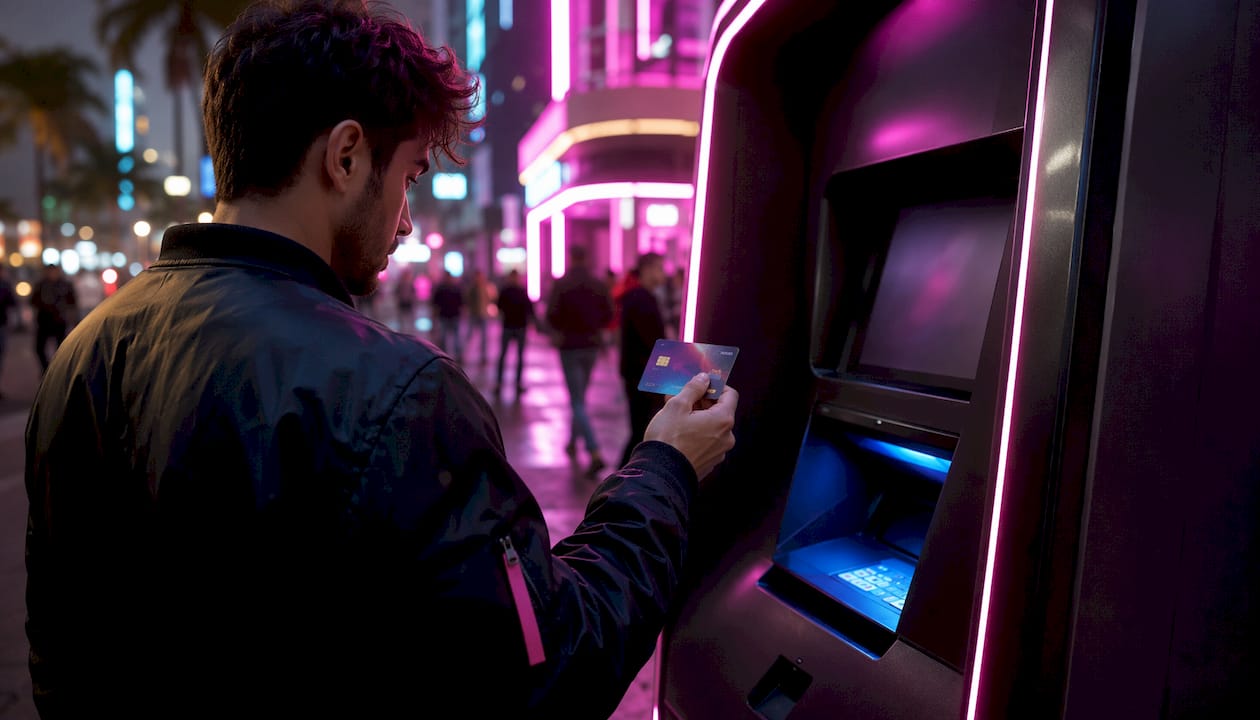
Leaked systems point to banks with variable interest rates, loan options, and branch-specific behaviors that react to district stability. Deposit too much at once and the system flags it. That's not a bug — it's a mechanic that pushes you toward laundering.
How you spend:
Consumables, vehicle repairs, property upkeep, business salaries, social spending, and investments. The flow matters: earn → store → launder → spend → reinvest. Skip the laundering step and your banked money becomes a liability.
What keeps money meaningful in late-game GTA 6?
GTA V had a spending problem. Once you hit a certain wealth level, money stopped mattering. Rockstar is addressing that directly with mandatory drains built into every layer of the game.
Ongoing maintenance costs:
- Vehicle upkeep and repair bills
- Business manager salaries (skip them and your passive income stalls)
- Property upkeep fees that scale with what you own
- Consumable restocking for weapons and gear
Automated drains:
- Tax and audit mechanics tied to how much traceable income you show
- Police seizure of pocket cash during arrests
- Fines and legal fees from wanted-level escalation
Late-game value preservation:
Escalating prices on rare vehicles and properties mean there's always something worth saving for. Limited inventory systems — hinted at in leaked development footage — force real choices between grabbing more loot and getting out clean. Laundering through front businesses like nightclubs converts dirty cash into traceable revenue, but it costs time and upkeep. That's the tension Rockstar is engineering.
Pro Tip: Buy low-maintenance passive businesses early. A nightclub with a solid popularity rating generates steady income without constant babysitting. Stack two or three of these before you chase high-risk heists, and you'll always have a cash floor to fall back on.
How does GTA 6 differ from GTA V's economy?
The gap is bigger than most fans realize. Here's the direct comparison across the dimensions that matter:
| Dimension | GTA V | GTA 6 |
|---|---|---|
| How to earn | Mission payouts, static heists, GTA Online grind | Dynamic heists, passive businesses, UGC revenue, market manipulation |
| How to spend | Limited sinks; money lost meaning fast | Maintenance costs, audits, consumables, escalating property prices |
| Creator monetization | None in-game | Likely UGC marketplace and revenue share (unconfirmed but signaled) |
| Late-game balance | Wealth cap made money irrelevant | Continuous drains and rare purchases keep money circulating |
| Consequences and world simulation | Static prices, disconnected stock market | Dynamic pricing, district-level scarcity, NPC behavior shifts |
The scenario difference is stark. In GTA V, you could rob the same store repeatedly with zero economic consequence. In GTA 6, flood a district with theft and prices spike there until supply recovers. NPC vendors may close. Rival factions may move in to fill the vacuum. The RAGE engine simulation is what makes that feedback loop possible — it's the technical foundation that separates GTA 6's economy from anything in the franchise's history.
Statistic callout: GTA Online's inflation problem grew so severe that vehicle prices reached the tens of millions while payouts were constantly adjusted upward just to keep pace — a textbook case of what Rockstar is actively designing against in GTA 6.
Can players actually earn real money from GTA 6's creator economy?
This is where things get genuinely exciting for creators. The model isn't confirmed yet, but the signals are clear enough to plan around.
Creator paths to watch:
- In-game UGC revenue share — if Rockstar builds a marketplace similar to Fortnite Creative's Support-a-Creator program or Roblox's Developer Exchange, creators can earn from player engagement with their custom content
- ️ Custom server hosting — paid experiences and private lobbies with entry fees
- Streaming and sponsorships — GTA 6's launch will be one of the biggest streaming events in gaming history; early creators with established audiences will capture the most traffic
- UGC drops — selling custom maps, missions, or cosmetics through official or third-party channels
Fortnite Creative and Roblox as the benchmark:
Fortnite Creative's island creator program pays creators based on player time spent in their experiences. Roblox's Developer Exchange lets creators convert earned Robux into real dollars. Both platforms prove that UGC revenue sharing can scale individual creators into meaningful income streams. Rockstar has the player base to dwarf both — the question is whether they build the payment plumbing.
Pre-launch steps for creators:
- Build your audience now on YouTube, Twitch, and TikTok around GTA 6 content
- Study Rockstar's creator tool announcements as they drop
- Prototype UGC concepts so you can ship fast at launch
- Set up payment channels (PayPal, Stripe, or platform-native) and review IP terms carefully
- Document your creative process — it protects you if disputes arise over original content
Post-launch steps:
- Drop UGC content in the first week while search volume is at its peak
- Run paid experiences or exclusive server events
- Use streaming sessions to funnel viewers directly to your UGC maps
- Cross-promote with other creators to grow discoverability fast
Pro Tip: Thumbnail and landing-page quality determines discoverability in UGC marketplaces just as much as the content itself. Treat your GTA 6 UGC like a product launch — design the cover before you finish the map.
What are the best ways to make money in GTA 6?
Ranked by playstyle, here's where to focus your energy:
Solo players
- Passive business stack — buy a nightclub and one production facility early; let them accumulate while you run missions
- Soloable heists — Rockstar is building solo-friendly high-payout heist structures that don't require a crew, similar to the Cayo Perico blueprint from GTA Online
- Dynamic world events — armored trucks and opportunistic grabs offer fast cash with low setup cost
- Stock market plays — sabotage a corporation through a mission, then buy low before the price recovers
Crew players
- Multi-stage heists — the highest single-session payouts in the game; split well and everyone wins
- Smuggling runs — high-risk, high-reward; decentralized fencing points reduce travel overhead and exposure
- Coordinated district control — flood a rival's supply chain to shift market prices in your favor
Creators and casual players
- UGC and streaming — build audience before launch, monetize at peak traffic
- Contracts and daily hustles — low-risk, repeatable, good for casual sessions without heavy commitment
The optimal sequence: Seed capital from early story missions → buy one low-maintenance passive business → run a soloable heist → reinvest profits into laundering capacity → scale into higher-return ventures.
Pro Tip: Never bank a large sum without laundering it first. Raw criminal proceeds deposited directly trigger audit flags. Run the money through a front business first, even if it costs you a percentage — it's cheaper than a frozen account.
How do your actions reshape Leonida's economy?
This is the mechanic that makes GTA 6 feel genuinely alive. Player behavior feeds back into the world in ways that create new opportunities and close others.
Supply-demand feedback loops:
- Rob a convenience store chain repeatedly and that district faces a supply shortage — prices climb until restocking happens
- Destroy a drug depot and the black market price for that product spikes city-wide
- Flood the stolen-goods market in one area and fencing prices drop there until demand recovers
NPC behaviors triggered by economic stress:
- Residents migrate away from destabilized districts
- Businesses close or board up when crime rates spike
- Rival factions move into economic vacuums you create
- Panic buying clears shelves before a scripted storm or police crackdown
World events that shift markets:
Storms, labor strikes, police crackdowns, and festivals all create temporary price swings. A festival in a district drives up demand for alcohol and entertainment. A police crackdown tanks black-market activity but spikes demand for clean laundering channels. These aren't random — they're systemic responses you can anticipate and trade around.
The RAGE engine simulation is what makes this scale. It's not just flavor; it's a tested model of how localized player behavior ripples outward across districts.
How do inflation and supply-demand actually work in GTA 6?
The mechanics go deeper than surface-level price changes. Here's how the system operates at a granular level.
Inflation mechanics:
Prices in GTA 6 aren't fixed to a vendor spreadsheet. They respond to local supply levels, player activity density, and world events. Repeatedly targeting the same economic node — a specific store, a supply depot, a fencing hub — causes localized inflation in that node's goods. The effect decays over time as supply is restored, but during the scarcity window, prices can climb significantly.
Player influence on supply and demand:
You're not just a participant in the economy. You're a market force. Destroy enough supply in a district and you effectively become a price-setter for that area's black market. Rival players or NPCs will try to fill the gap, which creates competitive dynamics in multiplayer. In single-player, the AI factions respond similarly — moving product into undersupplied areas to capture the margin you created.
Banking and interest dynamics:
Leaked systems describe variable interest rates and loan mechanics tied to district stability. A bank branch in a destabilized district may offer worse rates or restrict services. That means your choice of where to operate economically affects your access to financial tools — another layer of consequence that GTA V never had.
The player's macro role:
At scale, coordinated player behavior in GTA 6 Online could reshape entire regions of Leonida. A crew that systematically controls supply chains in one district effectively runs a monopoly. That's not a theory — it's the logical output of the simulation model Rockstar built.
Real-money monetization, microtransactions, and RMT: what you need to know
Rockstar hasn't confirmed GTA 6's microtransaction model, but the pattern from GTA Online is clear enough to read.
Types of real-money monetization to expect:
- Cosmetic microtransactions — the safest model for balance; skins and cosmetics don't affect gameplay power
- ️ Paid UGC marketplaces — creators sell experiences; Rockstar takes a platform cut
- Subscription tiers — GTA Online's GTA+ model suggests a subscription layer is likely
- Creator revenue share — possible but unconfirmed; would mirror Fortnite Creative's approach
Real-money trading (RMT) risks:
Third-party RMT — buying in-game currency for real cash outside official channels — carries serious risks. Rockstar's terms of service prohibit it, and enforcement in GTA Online included permanent account bans. Chargebacks from fraudulent sellers can also expose your payment method. The underground economy around RMT also attracts phishing schemes and account theft.
What to watch out for:
- Any site offering cheap GTA 6 currency for real money is almost certainly a scam or a TOS violation
- Never share account credentials with third-party "boosting" services
- ⚠️ Real-world legal exposure is possible if RMT crosses into fraud territory under US law
Player guidance: Stick to official channels. If Rockstar builds a creator revenue share program, that's the legitimate path to real-world income from GTA 6. Everything else is risk you're taking on voluntarily.
This article is general information, not legal or financial advice. Confirm current platform terms and applicable laws with a qualified professional for your specific situation.
Leonida's read: how we tracked these systems and why we believe they'll ship
Here's the methodology behind everything you've read above:
- Trailer and frame analysis — the Trailer Hub at Vicecitynexus tracks every frame of official Rockstar footage for UI elements, banking scenes, and economic indicators
- Leaked UI screenshot tracking — finance-related UI elements (bank account screens, deposit prompts, business revenue dashboards) have been catalogued and cross-referenced
- Developer earning statements — Take-Two investor communications confirm GTA 6 is designed as a long-term revenue system, which aligns with a deeper economic model
- Trade and financial analysis — industry analysts have noted that Rockstar's simulation tooling is specifically designed to model economic behavior before it ships
- Community signal aggregation — Nexus Investigations compiles and vets community-sourced leaks against official signals
The credibility of these claims rests on the convergence of multiple independent signal types: leaked development footage (partially confirmed by subsequent company actions), RAGE engine technical mentions in developer contexts, finance UI elements visible in official trailers, and analyst readings of Take-Two's financial disclosures. No single signal is definitive. Together, they point consistently in one direction.
Gabriel and the Vicecitynexus team have been tracking these signals since the first trailer dropped, cross-referencing every economic indicator against the franchise's history and Rockstar's known design philosophy.
Key Takeaways
GTA 6's economy is a reactive, simulation-driven system where every dollar you earn, store, or spend shapes Leonida's districts, NPC behavior, and your long-term progression.
| Point | Details |
|---|---|
| Bank your money fast | Pocket cash is vulnerable to police seizure; large deposits trigger audit flags, so launder first. |
| Stack passive businesses early | Low-maintenance businesses like nightclubs generate offline income and create a reliable cash floor. |
| Your actions move prices | Robbing or destroying supply in a district causes localized inflation until supply is restored. |
| Creators have real opportunities | UGC revenue share and streaming income are viable paths if Rockstar builds tools similar to Fortnite Creative or Roblox. |
| Vicecitynexus tracks it all | Vicecitynexus's Trailer Hub, Nexus Investigations, and AI Q&A keep you updated as confirmed details replace speculation before the November 19, 2026 launch. |
Why this economy changes everything for fans and creators
Here's my honest take: the most underrated thing about GTA 6's economic design isn't the dynamic pricing or the laundering mechanics. It's what those systems do to storytelling.
When money has real consequences — when your choices about where to rob, what to buy, and how to store your earnings actually reshape the world around you — the narrative stakes go up for everyone. Solo players get a game where their decisions compound over time. Crews get a competitive economic layer that makes multiplayer feel like running an actual criminal enterprise. Creators get a platform with genuine monetization potential if Rockstar delivers on the UGC infrastructure.
The conventional wisdom says GTA 6 will just be a bigger GTA V. That's wrong. The simulation model underneath the economy is a different class of design. It's closer to what you'd find in an economic strategy game than in a traditional open-world action title. That's not hype — it's what the technical evidence points to.
What I think gets overlooked is the creator angle. Most coverage focuses on heists and passive income. But if Rockstar builds discoverability and payment tools anywhere close to what Fortnite Creative offers, GTA 6 could become the largest UGC economy in gaming. That's a bigger story than any single heist payout.
Vicecitynexus is your GTA 6 economy command center

You've got the framework. Now you need the live updates. Vicecitynexus is the companion site built specifically for GTA 6 fans who want more than surface-level coverage — it's where economic signals get tracked, trailer frames get dissected, and every new leak gets vetted before it spreads as fact.
The Trailer Hub is where you'll find frame-by-frame breakdowns of every official Rockstar release, including the finance UI elements and banking scenes that back the claims in this article. Nexus Investigations goes deeper — long-form evidence dossiers on specific mechanics, updated as new signals emerge. The AI Q&A feature lets you ask specific questions and get answers grounded in tracked evidence, not guesswork.
With the November 19, 2026 launch locked in, the window to get ahead of the economy is now. Head to Vicecitynexus and start tracking.
Primary sources and further reading
These are the sources that back the claims in this article — ranked by how directly they address GTA 6's economic systems:
- GTA 6's Dynamic Economy: Black Markets, Banks & AI Explained — TechFusionDaily's deep dive into the RAGE engine simulation model, banking behaviors, and inflation mechanics. The most technically detailed public analysis available.
- Money Talks: The GTA 6 Economy System — Left Down Right Up's breakdown of maintenance costs, consumables, and the late-game spending problem fix. Strong on the money-sink mechanics.
- GTA 6 Money & Economy Guide 2026 — Covers passive business mechanics, offline income caps, and laundering systems in practical detail.
- GTA 6 Solo Money Guide — Community analysis of the soloable heist + passive business stack as the most efficient solo progression path.
- GTA 6 Stolen Goods Economy — Covers decentralized fencing points and how stolen-goods offload efficiency works across the map.
- GTA 6 Money and Economy: What We Know So Far — GTA Intel — The clearest separation of confirmed facts from speculation; essential for calibrating what's real vs. what's analysis.
- Vicecitynexus Nexus Investigations — Vicecitynexus's own evidence dossiers, updated as new trailer and leak signals emerge. The hub for ongoing economic tracking before launch.